Jim Whitney Economics 250

Wednesday, February 13, 2013

Homework exercises #6

Due: __________________________

Circle section: 12:50 / 1:55

Name: ______________________________
     
 
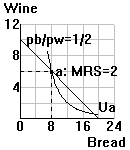
1. Consider a consumer with an income of $10 which she uses to consume 8 loaves of bread at $.50 per loaf and 6 bottles of wine at $1 per bottle. You learn that, with her current consumption bundle, she is willing to trade 2 bottles of wine for 1 loaf of bread and remain indifferent.
a. Is she maximizing her utility? If so, explain why. If not, explain briefly, and suggest the direction of change in consumption which would raise her welfare.
    No, she is not maximizing her utility.
     MRS=DW/DB=2 and Pb/Pw=.50/1.00=1/2, so relative value of B exceeds relative cost of bread => consume more bread, less wine.
    OR: She is willing to trade $2 of wine for $.50 of bread, so she should consume more bread and less wine--bread is the better bargain for her.
b. Illustrate her present situation in a budget line/indifference curve diagram (put bread on the horizontal axis), and clearly label the endpoints of her budget line, and the quantities she is presently consuming.
    See diagram to right.
whitespace.gif (816 bytes)
2. Suppose the price of X is equal to the price of Y.
a. Will everyone who consumes both X and Y have the same MRS at their optimum? Explain briefly.

    Yes. All consumers face the same relative price of both goods, so all consumers optimize by setting MRS=Px/Py. Here, Px/Py=1.


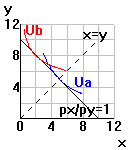
b. Will everyone who consumes both X and Y consume equal amounts of both goods? Support your answer with a diagram.

    No. Different consumers have different tastes. At the margin all value extra X and Y equally, but that can occur at various ratios of Qx to Qy.

whitespace.gif (816 bytes)


3. Suppose an individual consumes only two goods, X and Y, and derives the following utility from the quantities consumed of each good (quantities are represented by X and Y respectively):
            U(X,Y) = X 4/5 Y 1/5
Be sure to show your work for this problem.
a. What is the formula for the consumer's marginal rate of substitution (MRS), given this utility function?

    MRS = (Bx/By)·Y/X = ((4/5)/(1/5)).Y/X = 4.Y/X


b. What would the value of the consumer's MRS with a consumption bundle of X=16 and Y=36?

    MRS = 4.Y/X = 4.(36/16) = 4.(9/4) = 9


c. Denoting the prices of the two goods by Px and Py, state the tangency condition for a consumer optimum.

    TC: MRS = Px/Py => 4·Y/X = Px/Py


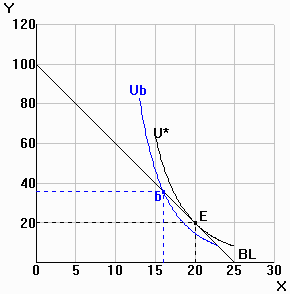
d. If Px = $4, Py = $1, and income (I) = $100, what consumption bundle will the consumer choose? In the diagram to the right,  illustrate (1) the consumption optimum and (2) the consumer's situation with the consumption bundle of part b. Be sure to label the budget line endpoints, the amounts consumed, the indifference curves, and the consumer's MRS for both cases.

        (1) 4·Y/X = $4/$1 = 4
        (2) 4·Y/X = 4  => Y=X
        (3) I = Px·X + Py·Y =>
            100 = 4·X + 1·Y, but Y=X so:
            100 = 4·X + 1·X = 5·X => X=20
        (4) Y=X => Y=20
        (5) TC: MRS = 4·(20/20) = 4 = Px/Py
            BC: 100 = 4·(20) + 1·(20)

axes.gif (4118 bytes)
whitespace.gif (816 bytes)