|
Wednesday, March 27, 2013 |
|
Homework exercises #16 |
||||||
|
|
1. |
(Frank, Ch.16) Bert has an initial endowment consisting of 10 units of clothing and 10 units of food. Ernie's endowment consists of 20 units of clothing and 10 units of food. Represent these initial endowments in an Edgeworth box for exchange. (Put clothing on the horizontal axis. Note: the axes just give you a place to draw your Edgeworth box; use only as much of each axis as you want in order to construct the box.) | ![]() |
|
2. |
Electric utility regulation has often resulted in high-volume consumers (H) paying lower prices for their additional consumption of electricity than do low-volume consumers (L). To illustrate the results, consider a consumer from each group, H and L, both of whom consume two goods, electricity (E) and other goods (G). | ![]() |
|
| a.. | Draw an Edgeworth box for exchange which illustrates their situation. Put electricity on the horizontal axis, and use the lower lefthand origin for H, the high-volume consumer. | ||
| b. | Add tangency lines to your indifference curves to contrast the MRS for the two consumers. | ||
| c. | What sort of exchange between these two consumers could raise
the welfare of both? Briefly explain why, and use your diagram to illustrate the
results of your recommended exchange.
|
||
|
3. |
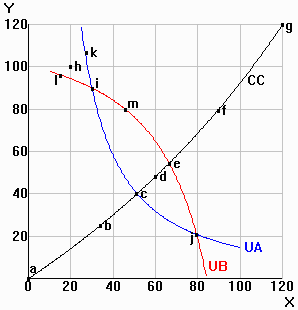
Consider the Edgeworth box for exchange depicted in the diagram to the right. The two consumers, A and B, are initially at allocation i in the diagram. CC denotes the contract curve. | ![]() |
|
| a.. | What quantities would you estimate make up the initial
allocation for each consumer? XA=______ YA=______ XB=______ YB=______ |
||
| b. | Which of the labeled allocation(s) would be considered Pareto
optimal?
|
||
| c. | Shade in the area which contains allocations which are Pareto superior to allocation i. | ||
| d. | Which of the labeled allocation(s) would be considered Pareto
superior to allocation i?
|
||
| e. | Illustrate the results of the the consumers
moving to allocation h. Would you be surprised if this happens, given their initial
allocation? Why or why not?
|
||
| f. | Illustrate the results of: (1) an exchange which moves the consumers to allocation e and (2) an exchange which moves the consumers to allocation m instead. | ||
|
4. |
Answer the following questions about the online
reading, "How to
Ration Water" (http://faculty.oxy.edu/whitney/xaccess/ec250/v_water.htm): |
![]() |
|
| a. | Explain why the plan adopted for the allocation of water in
Marin County will not lead to exchange efficiency. Use an Edgeworth Box diagram to
illustrate your answer (put water on the horizontal axis and other goods on the vertical
axis). Both households start out with the "flat
maximum number of gallons per day."
|
||
| b. | Explain how Friedman's proposal can make at least some better off without making anyone else worse off. In your diagram, show how his proposal can raise the welfare of both consumers. | ||