|
Friday, February 22, 2013 |
Contrasting price and income subsidies
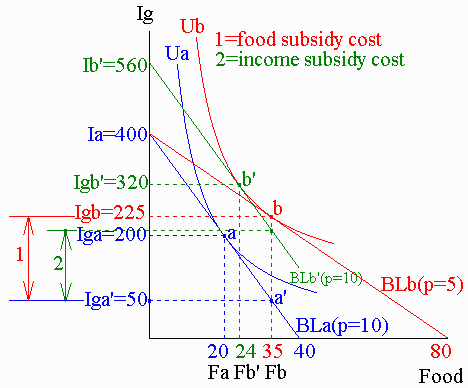
Consider the Smiths, a low-income family which has a $400 income to spend on food (F) [market price = Pmkt = $10 per meal], with the rest spent on other goods (Io).
Option 1: the government offers
a 50% food price subsidy, so the Smiths pay a subsidized price = Psub = $5 per meal
Option 2: the government offers the
Smiths a utility-equivalent income subsidy.
To do: Complete the following table:
| Consumption point | Money income | Pfood | Qfood | TEfood | Ig ($) | Cost to government | ||
| (0) | No subsidy | a | --- | |||||
| (1) | Food price subsidy | |||||||
| (2) | Utility-equivalent income subsidy |
Tax and rebate policy
Consider the following passage from N. Gregory Mankiw's blog, Thursday, February 05,
2009
My Preferred Fiscal Stimulus
Regular readers of this blog have a pretty good sense of my
policy preferences. But for those occasional readers who might be
stopping by, let me reiterate what I would do right now if I were the
fiscal king.
I would institute an immediate and permanent reduction in the
payroll tax, financed by a gradual, permanent, and substantial increase
in the gasoline tax. I would make the two tax changes equal in present
value, so while the package results in a short-run budget deficit, there
is no long-term budget impact. Call it the create-jobs,
save-the-environment, reduce-traffic-congestion, budget-neutral tax
shift.
How would that work?
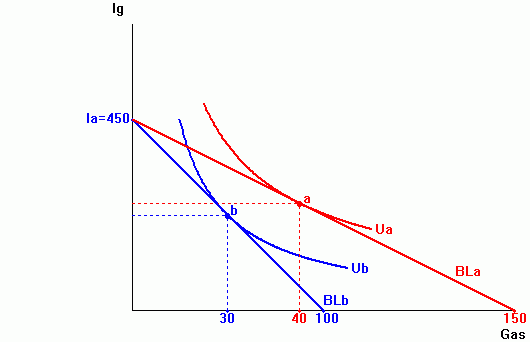
To do: Complete the following table and answer the two questions below
the table:
(Hint: you might find it helpful to answer the two questions below the table
before trying to complete row (3) of the table)
| Consumption point | Money income | Pgas | Qgas | TEgas | Ig ($) | ||
| (1) | Before tax/rebate | a | |||||
| (2) | $1.50 gas tax with no rebate | b | |||||
| (3) | Gas tax with payroll tax rebate |
c |
34 |
Characteristics of the final new optimum with the gas tax revenue
exactly matched by a cut in payroll taxes:
(1) Circle the budget line you would be on: BLa / BLb
(2) What would be the value of your optimal MRS? $_________