 Homework exercises #18 |
Name: __________________________________ |
|
Homework exercises #18 |
Name: __________________________________ |
|
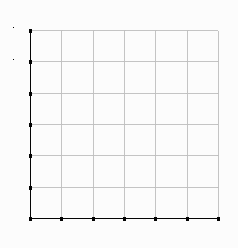
| 1. | The diagram to the right is an Edgeworth box for inputs. The isoquants indicate the economy's output of its only two goods, X and Y. In the diagram to the far right, use a production possibilities frontier to plot points which could correspond to the points labelled A, B, C, D and E in the Edgeworth box. The curved line running from 0x to 0y in the diagram is the contract curve for X and Y. | 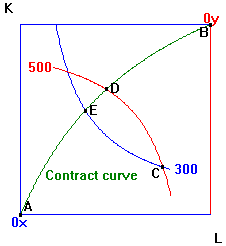 |
 |
|
|||
| 2. | For each of the following, state which of the 3 efficiency conditions, if any, are violated and why. For each case that you think is efficient, explain briefly. | |
| a. | The government imposes a per-call tax on all phone calls.
|
|
| b. | The government imposes the policy of part a, but the first 60
calls made by a household each month are tax-free.
|
|
| c. | Long-distance phone rates are higher during the day (when
congested phone lines raise the costs of service) than they are at night.
|
|
| d. | The price for local telephone calls is the same regardless of
how long the call lasts.
|
|
|
||
| 3. | Consider an economy which uses labor (L) and capital (K) to produce and consume two goods, soft drinks (S) and granola (G). Suppose that there is growing political pressure for some policy to reduce the output of S by 20 percent. Three suggestions have been proposed: | ||
| (1) | a tax on soda sufficiently high to reduce output by 20 percent; | ||
| (2) | a price ceiling on soda sufficiently low to reduce production by 20 percent; or | ||
| (3) | a tax on the labor (L) hired by soda manufacturers, set high enough to reduce output by 20 percent. | ||
| a. | Which efficiency condition is violated by all
three of these proposals and why?
|
||
| b. | Considering each proposal separately, which additional efficiency condition, if any, could the proposal violate and why? | ||
|
|||