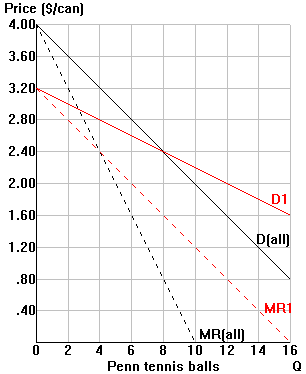
 The diagram to the right
depicts Penn's sales of tennis balls. Penn's current output and price:
The diagram to the right
depicts Penn's sales of tennis balls. Penn's current output and price: Output = 8
Price = 2.40
Oligopoly conduct: Example 2 Kinked demand theory
The diagram to the right
depicts Penn's sales of tennis balls. Penn's current output and price:
Output = 8
Price = 2.40
Penn realizes that its demand is more elastic if it changes its price and its rivals do
not change their price at the same time.
D1 = Penn's demand if only Penn changes its price
Dall = Penn's demand if Penn and its rivals change their price
together.
Suppose that Penn assumes:
a. if it raises its price, its rivals will NOT change their price, and
b. if it lowers its price, its rivals WILL also lower their price.
1. Indicate Penn's perceived demand curve if Penn raises its price. Indicate also Penn's corresponding marginal revenue curve.
2. Indicate Penn's perceived demand curve if Penn lowers its price. Again, indicate Penn's corresponding marginal revenue curve.
3. For future reference, link together your two marginal revenue segments.
4. Complete the following table of Penn's profit-maximizing quantity and expected price for each of the following constant cost marginal cost curves:
| Case | Marginal cost |
Penn's profit-maximizing... | |
| Quantity | Price | ||
| 1 | $.80 | 8 | $2.40 |
| 2 | 1.20 | ||
| 3 | 1.60 | ||
| 4 | 2.00 | ||
| 5 | .40 | ||
5. Note: D1 and Dall both cross at point a, Penn's current output and price combination. Is it just coincidence that MR1 and MRall also cross at Penn's current price of $2.40? Why or why not?